
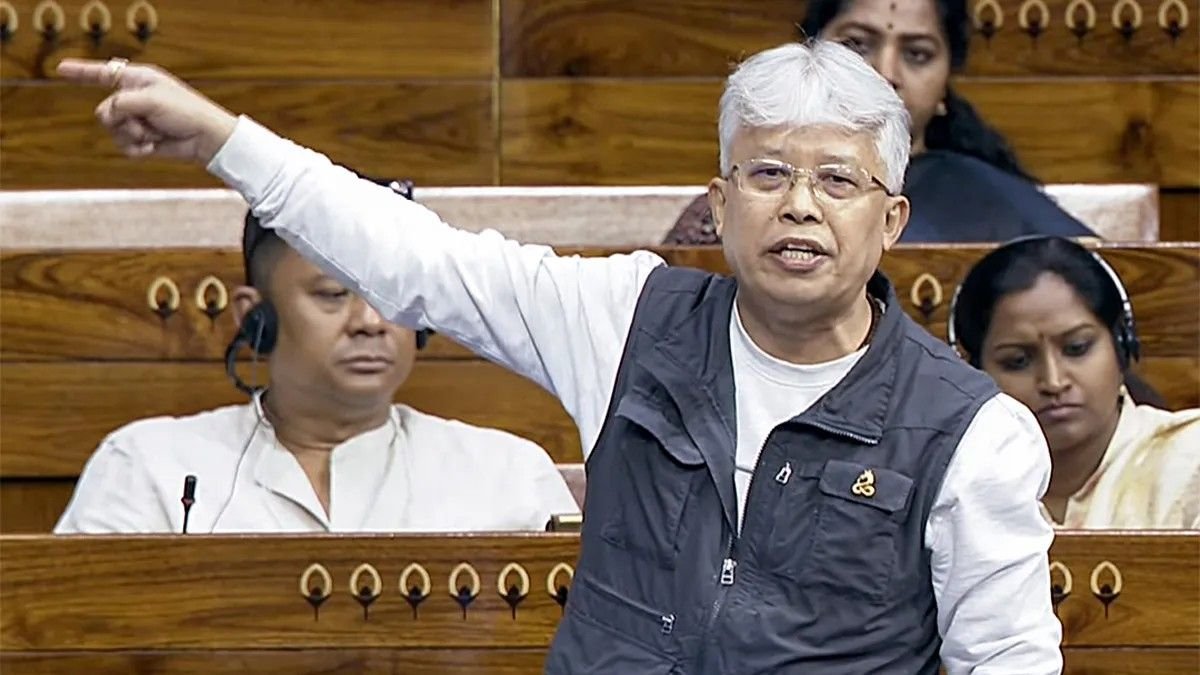
Congress MP Bimol Akoijam submitted a letter to Union Home Minister Amit Shah on Monday urging the latter to defer the census and delimitation exercise in Manipur until the government conducts the National Register of Citizens (NRC) exercise to update the National Register of Indian Citizens (NRIC), as mandated by the amendment to the Citizenship Act, 1955, in 2003, which was unanimously passed by the Parliament, so that a reliable citizen database is first established in the state of Manipur before any census-linked delimitation exercise is undertaken in the state.
In the letter, MP Bimol stated that while conducting such an exercise, it must be ensured that mechanisms to address the limitations experienced in Assam are taken care of so that the genuine and legitimate citizens do not get victimized. Along with this, the government must also set up a Foreigners Tribunal for Manipur under the Immigration and Foreigners Act, 2025, so that aliens/foreigners are delineated from the genuine citizens and that the process is carried out in a lawful, fair, and time-bound manner, it stated.
The MP stated that in order to do this, the law and order situation in Manipur must also be taken care of, and the illegal armed groups that are running parallel authority in the state, especially in remote areas, must be brought under control and made accountable so that any verification exercise can be conducted peacefully, transparently, and without coercion.
There is a widespread apprehension regarding the presence of illegal immigrants in the state of Manipur. This concern is understandable, as the state has a porous international boundary, and the unstable situation in neighboring Myanmar has led to a large inflow of alien subjects into the state, which is a recorded fact. It must also be noted that immigrants from Southeast Asia, particularly erstwhile Burma (now Myanmar), into Manipur, are not new. Historically, immigrants from Southeast Asia have been coming into the state, more perceptibly from the mid-19th century onwards, the letter stated.
However, these immigrants should not be conflated with alien subjects who have crossed over during the postcolonial period, even as Manipur absorbed a huge population from the erstwhile Burma following its independence in 1948 and abolition of the foreign regulation permit system in 1950 by the then chief commissioner of the state, it stated.
Moreover, the demographic impact on India’s Northeast, including Manipur, due to the developments in the erstwhile East Pakistan (now Bangladesh) is also a known fact. Furthermore, there is also a perceptible concern amongst local stakeholders and civil society groups that such illegal immigrants might have been encouraged and later allowed to be absorbed into the local population by politicians as their vote banks and vested interest groups to serve their sectarian agendas, often by denying the difference between citizens and non-citizens on the basis of ethnicity, the MP stated.
What has deepened the public anxiety about these illegal immigrants is the concern being raised on their involvement in the present crisis in Manipur, including the menace of the illicit drug business, often exemplified by the arrests and recovery of banned psychotropic substances and the massive presence of illicit plantations of poppy, extending the sphere of the “Golden Triangle” to the State of Manipur, it stated.
An objective assessment is required to distinguish the citizens from the non-citizens in the state of Manipur to ensure that genuine citizens are not victimized and communities do not get demonized through false narratives. Additionally, we must also objectively resolve the anomalies of the controversial census and ensure that the faulty census data does not become the basis for any delimitation exercise, the MP stated.