
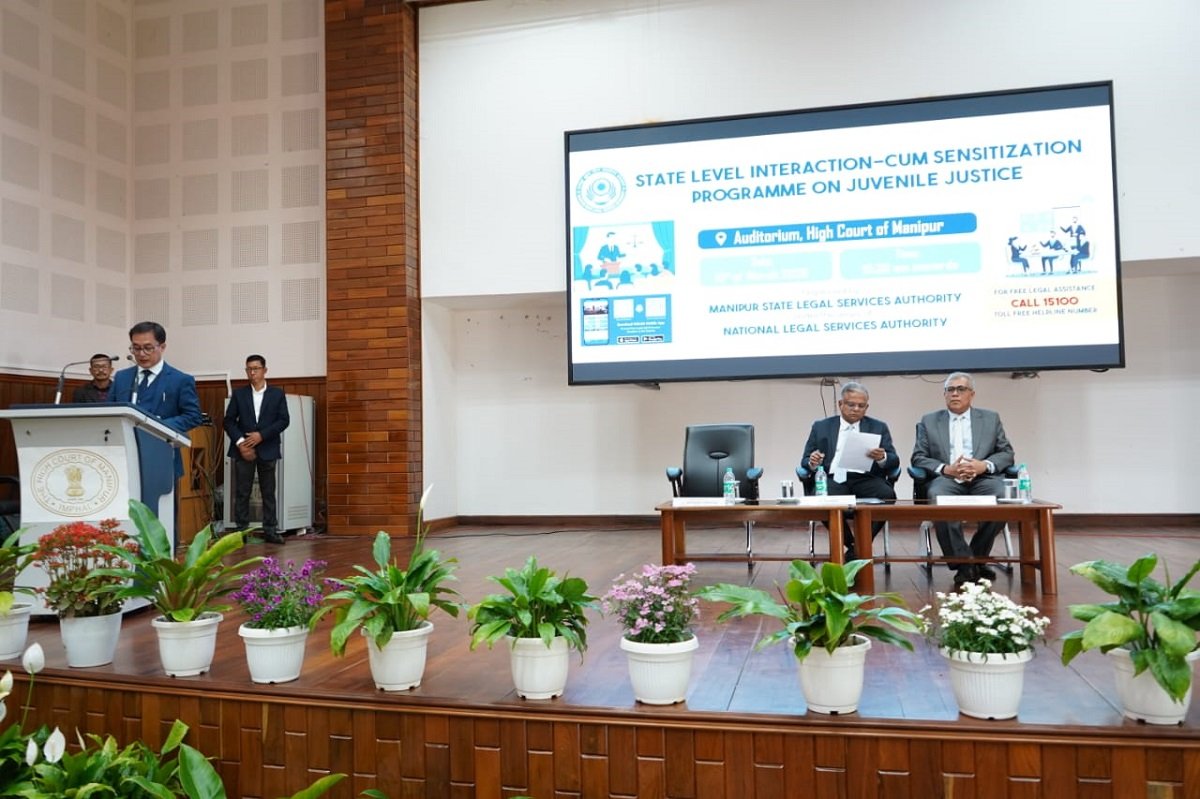
The Manipur State Legal Services Authority (MASLSA) organized a State Level Interaction cum Sensitization Program on Juvenile Justice at the auditorium of the High Court of Manipur.
The program was graced by Justice M. Sundar, Chief Justice, High Court of Manipur, as Chief Guest; Justice A. Bimol Singh, Executive Chairman, MASLSA; and Justice A. Guneshwar Sharma, Judge, High Court of Manipur cum Chairman, HCLSC, as Guests of Honor.
Among others present on the occasion were Ojesh Mutum, Registrar General, High Court of Manipur; Alek Muivah, Member Secretary, MASLSA; Monalisam Maibam, Registrar (Vigilance), High Court of Manipur; K. Nirojit, Secretary, High Court Legal Services Committee; and S. Mangaleibi Devi, Additional Member Secretary, MASLSA.
The program witnessed participation from the Director, Social Welfare, Government of Manipur; secretaries of District Legal Services Authorities; principal magistrates and members of the Juvenile Justice Boards (JJBs); chairpersons and members of the Child Welfare Committees (CWCs); superintendents of police; representatives from the Department of Clinical Psychology of the Regional Institute of Medical Sciences (RIMS); legal aid defense counsel; paralegal volunteers; members of legal services units for children; and legal aid counsel attached to JJBs and CWCs.
In his address, Justice Sundar emphasized that juvenile justice is not merely a legal issue but an important social responsibility. He remarked that children are often described as “uncut diamonds” whose potential may be dimmed by adverse surroundings, and how society treats children in conflict with law reflects its commitment as a civilized society.
He further highlighted that the Juvenile Justice (Care and Protection of Children) Act, 2015, aims to balance compassion with accountability and focuses primarily on rehabilitation through counseling, education, and vocational training. He also explained the roles of statutory bodies such as the Juvenile Justice Board and Child Welfare Committee, which function at the district level to address the needs of children in conflict with law and children in need of care and protection.
The Chief Justice stressed the importance of effective implementation of the Act through adequate infrastructure, trained professionals, and coordination among stakeholders, including the Police Department, Social Welfare Department, and experts from the Department of Clinical Psychology of the Regional Institute of Medical Sciences (RIMS). He urged participants to actively engage in the discussions and contribute their insights for strengthening the juvenile justice system.
He concluded by emphasizing that the true measure of a justice system lies not in the number of individuals punished but in the number of young lives successfully rehabilitated and reintegrated into society.
In his address, Justice Bimol emphasized that the essence of the juvenile justice system lies in safeguarding the rights and future of children. He observed that true and lasting peace in society can only be achieved by ensuring the protection, care, and well-being of children. He stated that discussions on juvenile justice go beyond legal procedures and concern the life and future of every child.
He highlighted the crucial role played by the Social Welfare Department in
implementing the Juvenile Justice (Care and Protection of Children) Act through the establishment of child care institutions such as observation homes and special homes and through the functioning of district child protection units. He also underlined the significant responsibilities of the child welfare committees in
addressing the needs of children in need of care and protection, including the
preparation of individual care plans.
Justice Bimol further noted that one of the key challenges in Manipur is the establishment of observation homes in every district to ensure that distance does not delay the disposal of cases involving children. Stressing the importance of strict compliance with the provisions of the Juvenile Justice Act, he stated that every child alleged to be in conflict with law must be produced before the Juvenile Justice Board within 24 hours of apprehension and must never be kept in police lock-ups or jails.
He cautioned that failure to adhere to these safeguards may render the detention illegal and invite disciplinary as well as legal consequences for the responsible officers. Concluding his address, he expressed hope that the program would strengthen coordination among stakeholders and ensure timely and child-friendly justice delivery, as delays in the system could adversely affect the future of children.
Justice Guneshwar emphasized in his address that the Juvenile Justice Act is not adversarial in nature but reformative, focusing on the rehabilitation and reintegration of children involved in legal proceedings back into society. He stressed that the primary objective of the act is the welfare and reform of the child. Justice A. Guneshwar Sharma highlighted that all stakeholders play a crucial role in achieving this objective. He noted that any lapse in the duties or responsibilities of stakeholders could hinder the effective implementation of the Act. He further underlined the significant roles played by institutions and authorities under the Juvenile Justice framework, including the Juvenile Justice Board (JJB), Child Welfare Committee (CWC), probation officers, police, the Social Welfare Department, and the state government.
During the session, representatives from various stakeholder departments, namely Sheikh Abdul Hakim, Director, Social Welfare Department; Roni Mayengbam, MPS, Superintendent of Crime Against Women & Children, Manipur Police Department; Ms. Pampak Khumukcham, Assistant Professor, Department of Clinical Psychology, RIMS; and Mr. Potshangbam Praveen Kumar, Judicial Magistrate First Class, Imphal East-cum-Principal Magistrate, JJB, Imphal East, shared their experiences and highlighted the challenges faced in the course of their work. They also addressed queries raised by the participants during the interactive session.