
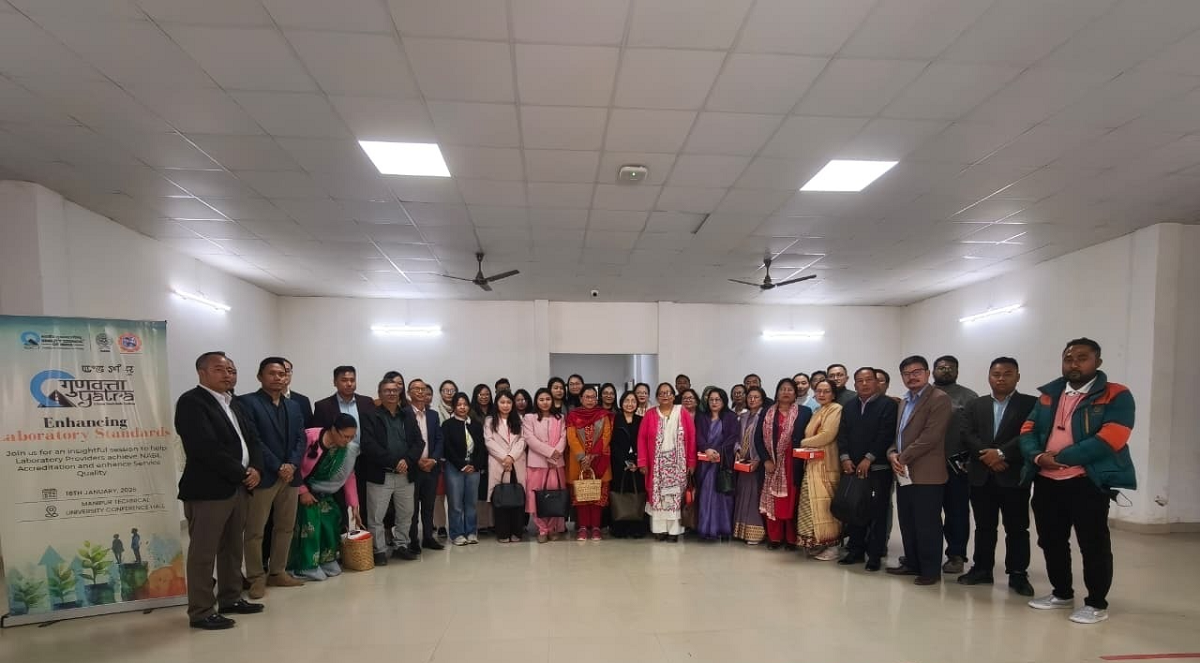
The limited number of NABL-accredited laboratories in the State emerged as a key concern during an awareness programme on NABL Accreditation and Its Benefits, held at Manipur Technical University (MTU), Imphal, under the Gunvatta Yatra Initiative of the Quality Council of India (QCI). The programme was organised by the National Accreditation Board for Testing and Calibration Laboratories (NABL), a constituent board of QCI under the Department for Promotion of Industry and Internal Trade (DPIIT), Ministry of Commerce and Industry, Government of India, and was hosted by the Department of Civil Engineering in collaboration with the Intellectual Property Rights (IPR) Cell, MTU. The awareness programme aimed to educate industries, laboratories, and academic institutions on the importance of NABL accreditation in ensuring quality, technical competence, and global acceptance of testing and calibration results. The Gunvatta Yatra Initiative is a flagship effort of QCI to promote a strong culture of quality, particularly in Tier-2 and Tier-3 regions of the country.
Ashutosh Debnath, NABL Consultant, served as the resource person and delivered an insightful presentation on the accreditation process, eligibility criteria, and benefits of NABL accreditation. He highlighted how accreditation enhances customer confidence, strengthens laboratory management systems, and enables international recognition. He also drew attention to the scarcity of NABL-accredited laboratories in the State, emphasising the urgent need to strengthen quality infrastructure. The programme witnessed the participation of more than 50 professionals, with maximum representation from the Regional Institute of Medical Sciences (RIMS), the Directorate of Environment and Climate Change, Manipur Technical University (MTU), Dhanamanjuri University (DMU), and other sister universities in the State. Participants included laboratory professionals, QA/QC heads, industry representatives, faculty members, researchers, and students.
As part of the programme, the participants also took the “Quality Bharat Pledge”, reaffirming their commitment to promoting quality, standardization, and best practices in their respective institutions and professional domains. Speaking at the occasion, Kosygin Leishangthem, Course Coordinator, Nodal Officer of the IPR Cell, and Faculty member of the Department of Civil Engineering, MTU, emphasised the relevance of such awareness programmes in fostering industry–academia collaboration and aligning institutional practices with global quality standards. The organizers highlighted that initiatives like this play a crucial role in improving laboratory competence and enhancing the State’s preparedness for national and international competitiveness. The programme concluded with an interactive session followed by a vote of thanks, expressing gratitude to NABL, QCI, university authorities, the resource person, and all participants for making the event a success.