
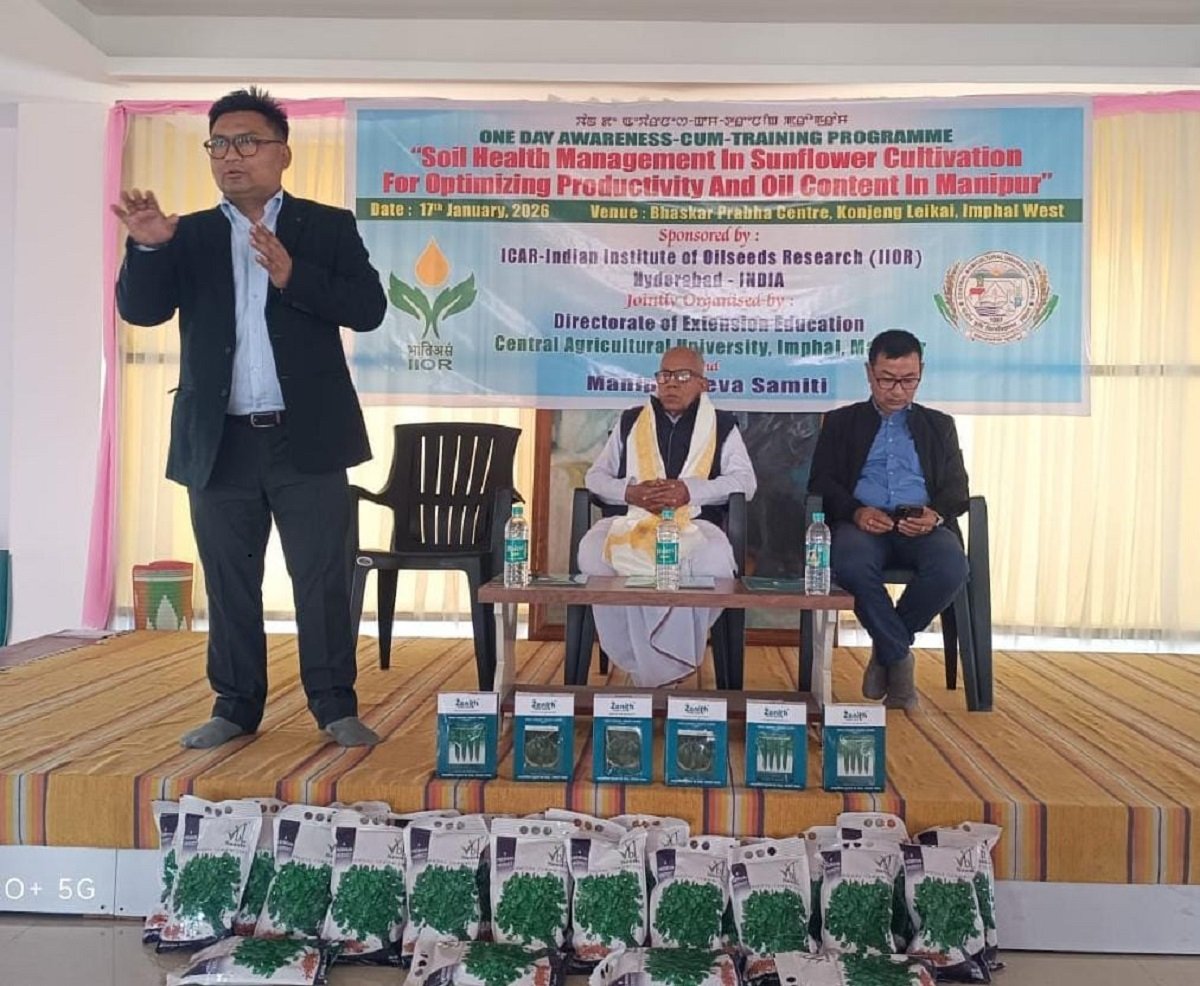
A one-day awareness and technical programme on “Soil Health Management in Sunflower Cultivation for Optimizing Productivity and Oil Content in Manipur” was jointly organised by Central Agricultural University (CAU), Imphal and Manipur Seva Samiti at Bhaskar Prabha Centre, Konjeng Leikai, Imphal West.
The programme was attended by farmers, students, and agricultural practitioners from Konjeng Leikai. The workshop aimed to enhance awareness about soil health management, scientific soil sampling, proper soil testing, and improved cultivation practices to increase crop yield and oil content in sunflower cultivation across the state. The resource persons for the programme included Prof. Thokchom Robindro Singh, former Deputy Director, Central Agricultural University; Laishram Jatra Singh; and Dr. Birendrajit Singh (Extension), Central Agricultural University (CAU).
The experts emphasised the importance of soil testing prior to crop cultivation and highlighted scientific methods of soil collection and preparation as prescribed by CAU.Speaking at the programme, Dr. Birendrajit Singh (Extension) stated that continuous and improper cultivation without understanding soil health leads to long-term soil degradation. He stressed that soil testing helps farmers identify nutrient deficiencies, assess crop suitability, and determine the correct quantity of agricultural inputs required.
It was informed that soil testing should ideally be conducted once every three years to ensure sustainable farming practices. The speakers also cautioned against the excessive use of chemical fertilisers, particularly urea, noting that overuse can increase nitrate levels in soil and water, potentially leading to health hazards such as blue baby syndrome. Maintaining soil health, they said, is crucial not only for crop productivity but also for water conservation and environmental balance.
During the technical session, participants were briefed on proper soil sampling techniques, including collecting soil samples in a zig-zag pattern, avoiding field boundaries, collecting samples from multiple locations, drying and mixing the soil properly, and taking samples from a depth of 15–20 cm for accurate testing. The programme concluded with an interactive discussion session, during which participants raised queries related to soil management and sustainable agricultural practices. The organisers expressed hope that the programme would encourage scientific farming practices and contribute to improving sunflower cultivation in Manipur.