
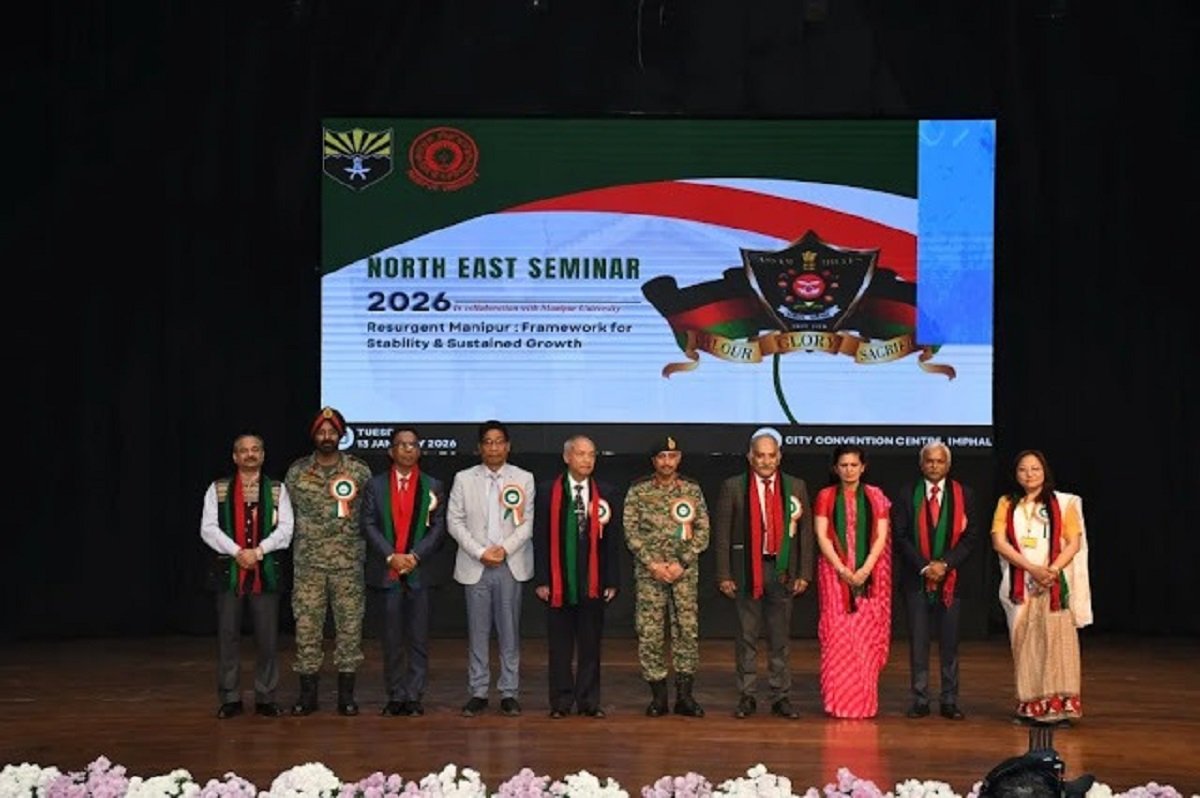
The Thadou Academic Society (TAS) has appreciated the Assam Rifles and Manipur University for organizing the North-East Seminar 2026 on “Resurgent Manipur: Framework for Stability & Sustained Growth” on January 13, saying the event offered valuable discussions on security, governance, reconciliation, and development. In a press release, TAS representing Thadou scholars, researchers, and citizens, said it is committed to preserving Thadou identity within Manipur’s multi-ethnic framework.
While most seminar contributions were constructive, TAS categorically rejected the portrayal of Manipur as a “tri-ethnic state” of only Kuki, Naga, and Meitei, as wrongly stated by some in the first plenary session. This characterisation is factually false, historically indefensible, and politically destabilising. It erases Manipur’s long recognized multi-ethnic reality and reduces a complex civilisational society into an administratively convenient but dangerous fiction, it said.
TAS endorsed Banita Naorem, IRS, who rightly affirmed Manipur’s multi-ethnic character and the need for accurate identification of indigenous communities of the state. Mislabelling—rooted in colonial-era errors—has caused lasting harm and contributed significantly to the 2023 Manipur crisis, it said. TAS called on all state institutions, especially defence personnel particularly Indian Army, academic and government institutions and agencies to immediately abandon the reductive Kuki–Naga–Meitei framework in administration, recruitment and reservations (including Agniveer), data, entitlements and official discourse. This artificial grouping breeds mistrust and undermines peace, it added. Indigenous peoples of Manipur are constitutionally recognised as Meitei, Meitei-Pangal, and Scheduled Tribes (ST). The blanket use of “Kuki” for ST communities—Thadou, Paite, Vaiphei, Hmar, Mizo, Simte, Gangte, Zou, Aimol, Kom, and others—despite their repeated rejection of the term ‘Kuki’, is unjust and misrepresents distinct identities. These communities must be named precisely and respectfully, it said.
There is no singular indigenous “Kuki” ethnic group in Manipur. The administrative category “Any Kuki tribes,” introduced in 2003 and recording only 28,342 people in the 2011 Census, was created with inadequate ethnographic consultation. As a limited and procedurally flawed classification, it cannot override the self-identified ethnic identities of distinct indigenous communities—such as Thadou and others—nor justify homogenising historically diverse groups. Persistent mislabelling, whether from ignorance or deliberate disregard, risks legitimising radicalised Kuki narratives that fuel exclusion, instability, and violence. Misidentification is not a semantic issue; it is a core driver of conflict in Manipur, it said.
TAS urged policymakers, security forces, academia, and media to reject inaccurate labels, recognise Manipur’s true multi-ethnic nature, and support dialogue based on truth, mutual respect, and renunciation of violence and separatist rhetoric. The Thadou people reaffirm their commitment to peace, coexistence, education, and Manipur’s shared progress, it added.