
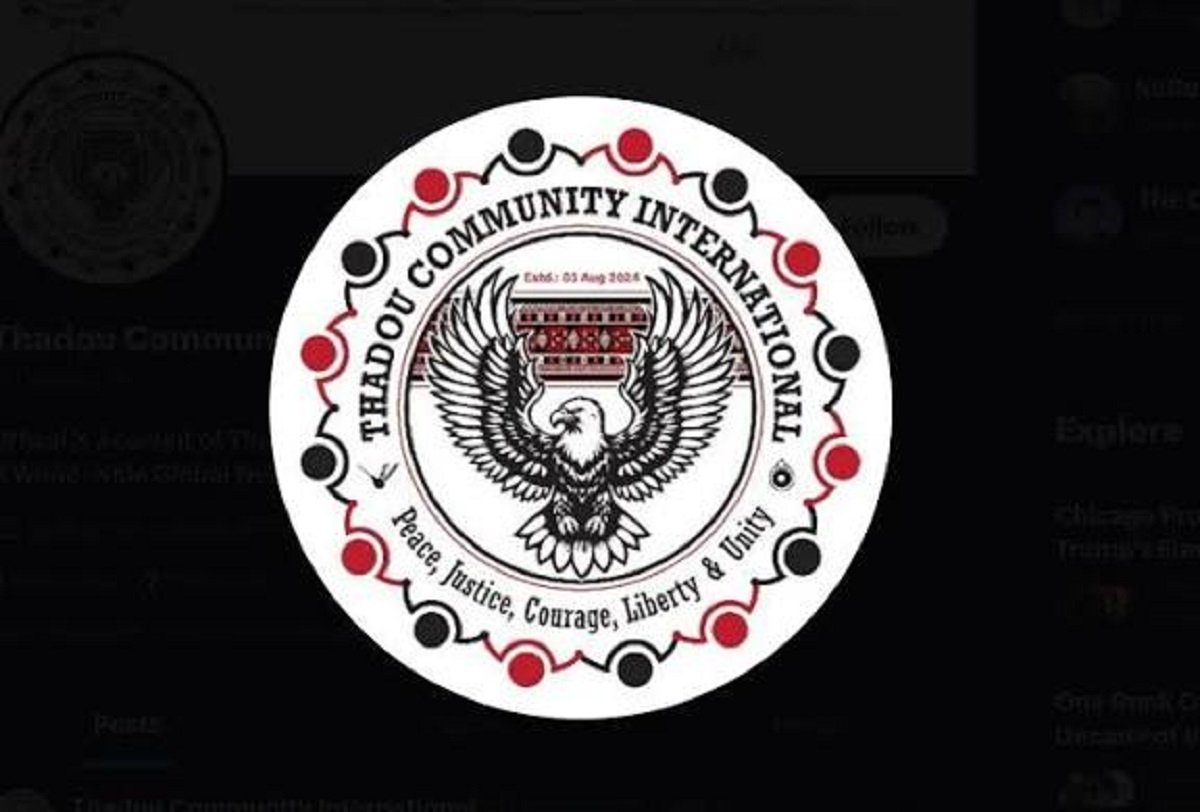
The Thadou Community International (TCI) has categorically rejected the false portrayal of Manipur as a so-called “tri-ethnic state” comprising Kuki, Naga, and Meitei, stating that this narrative is a deliberate fabrication with grave consequences. It is factually incorrect, historically indefensible, and politically dangerous. Its continued propagation has distorted public understanding, legitimised ethnic misrepresentation, and directly fuelled division, instability, and violence in Manipur, the Thadou body stated. According to a press release of TCI, Manipur is a multi-ethnic state, comprising the Meitei, Meitei-Pangal, Scheduled Tribes, and other communities who have lived in Manipur for generations. This is not a matter of opinion but a historical, constitutional, and demographic fact. Any attempt to compress Manipur’s complex indigenous reality into an artificial tri-ethnic framework constitutes ethnic erasure, undermines peace, corrodes social cohesion, and obstructs genuine progress.
TCI acknowledged the growing public recognition that accurate identification of indigenous peoples is non-negotiable, and this awareness must now translate into decisive institutional and community action. Peace cannot be built on falsehoods, and stability cannot be sustained through deliberate misclassification, it added. It stated that the persistent misuse of ethnic labels—particularly the coercive and blanket application of “Kuki” to non-Kuki Scheduled Tribe communities such as Thadou, Paite, Vaiphei, Hmar, Mizo, Simte, Gangte, Zou, Aimol, and Kom—despite their repeated rejection of the “Kuki” label, constitutes a grave injustice, causes deep and lasting harm, and has been a key structural factor in the 2023 Manipur crisis as well as in past ethnic conflicts.
It stated that the level of radicalization among Kuki-identifying individuals of all ages—including youths, children, church leaders, and members, as well as Kuki CSO and militant leaders and members—by violent Kuki ideology is a grave and growing threat. TCI called on all state institutions—including central and state governments, security agencies, academic bodies, and the media—to immediately abandon the politically engineered tri-ethnic framework in administration, recruitment processes, data classification, and official discourse. This construct institutionalizes division, entrenches mistrust, and directly undermines peace-building efforts, it stated. Constitutionally, Manipur’s indigenous peoples are recognised under Meitei, Meitei-Pangal, and Scheduled Tribe (ST) categories, including the original 29 tribes fully recognised under the 1956 Presidential Order. Any deviation from this framework is administratively irresponsible and politically motivated.
There is no indigenous ethnic group called “Kuki” in Manipur. Officially, the term appears only under the unconstitutional and undefined category “Any Kuki tribes,” created in 2003 for political purposes, which recorded a population of just 28,342 in the 2011 Census. “Kuki” is neither a community nor an indigenous group; rather, it represents a violent political and supremacist ideology, intertwined with pseudo-Christian cult narratives involving Kuki militant and church groups—such as the KNO, KCC, and KWS—and enforced through manipulation, coercion, force, violence, cancel culture, and political power. This artificial and dubious category cannot be used to erase the distinct identities of Manipur’s diverse indigenous peoples or to impose a homogenized label upon them, it stated.
It is a well-documented fact that the Thadou and other indigenous communities of Manipur are recognized ethnic groups in Myanmar, with a long-standing historical presence. In contrast, the term “Kuki” carries no recognized ethnic status in Myanmar. On the contrary, Thadou and other indigenous groups have suffered armed attacks at the hands of Kuki militants. Despite repeated efforts, those identifying as “Kuki” have been unable to secure recognition due to the absence of historical, ethnographic, or legal basis. However, in case of Manipur, India, the term “Kuki” was inserted into Manipur’s Scheduled Tribe list in 2003—primarily for narrow political and vote-bank considerations—despite the sustained objections from Thadou organizations dating back to the 1980s, it stated. It stated that the violent ethnic conflicts in Manipur since the 1990s—including the Kuki–Thadou, Kuki–Naga, Kuki–Zomi, and Kuki–Meitei clashes—appear to be driven primarily by misidentification linked to Kuki supremacist and separatist agendas. Evidence suggests that there are vested interests both inside and outside the state seeking to destabilize Manipur by fostering divisions among its communities, it added.
While Manipur’s territorial integrity will remain intact, the persistence of conflict is probable as long as the tri-ethnic framework—which politicizes ethnic identities and promotes, division, competition or hostility among groups—is maintained and reinforced, it added.
TCI called upon policymakers, security institutions, academia, and the media to reject imposed and inaccurate labels under “Kuki,” to recognize Manipur’s multi-ethnic reality, and to act responsibly in the collective pursuit of harmony, stability, and a genuinely resurgent Manipur. Until ethnic communities are accurately identified and Manipur is recognized as a multi-ethnic society, efforts will merely treat the symptoms rather than address the root causes of conflict. The people of Manipur have already suffered the consequences of ignoring this truth. It is long overdue for the people to awaken to the future of Manipur society, it added.