
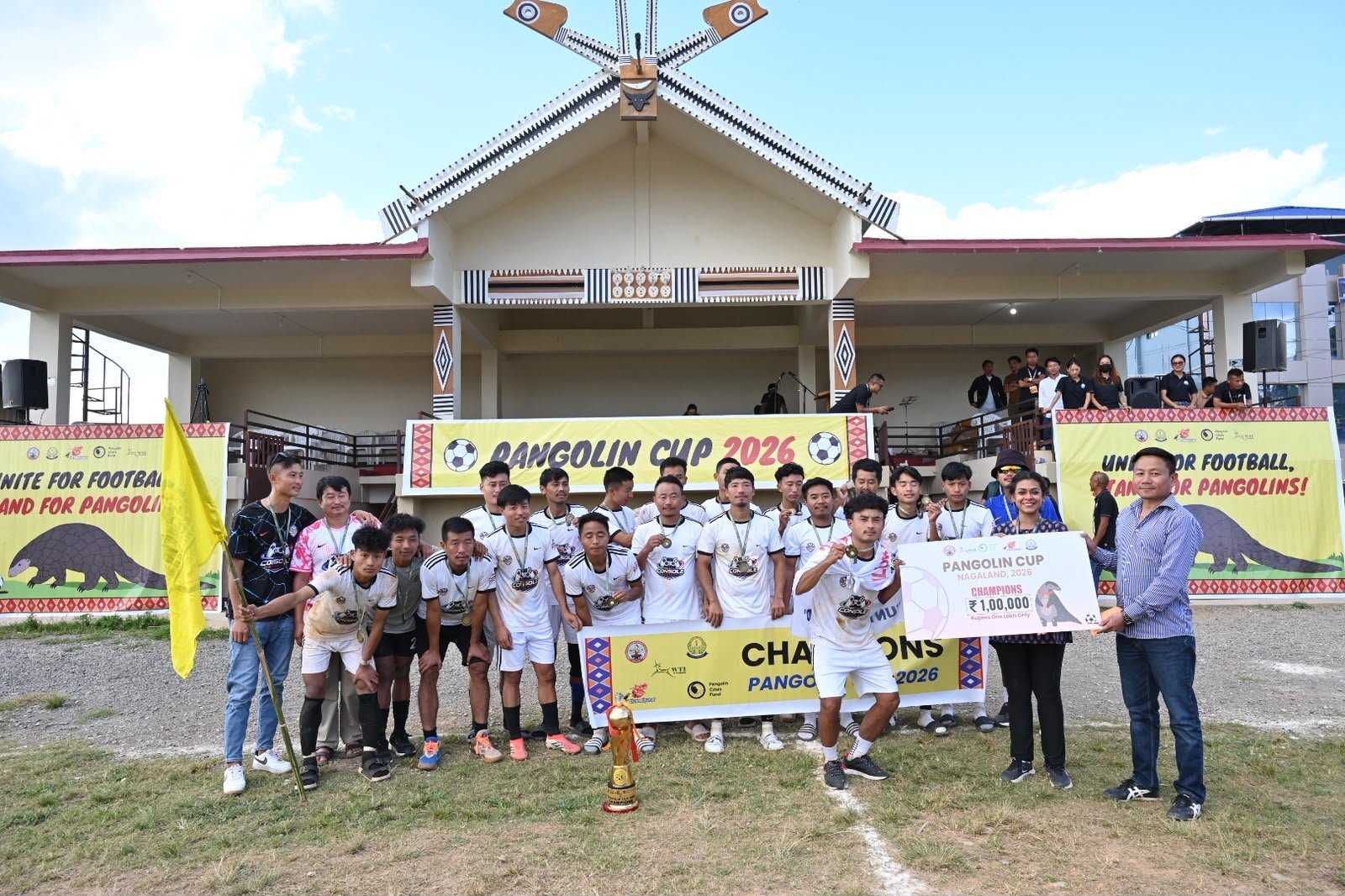
Meluri Town FC emerged champions of the second edition of the Pangolin Cup 2026, defeating Knight Riders Club from neighbouring Phek district in the final. The six-day football tournament featured eight local teams competing for the prestigious title.
Along with the championship trophy, the winning team received a cash prize of ₹1 lakh, while all participating players were awarded medals and certificates.
The Pangolin Cup was first launched in 2025 in Senapati, Manipur, under the Countering Pangolin Trafficking in the Indo-Burma Border initiative. This year’s tournament was hosted by the Meluri Range Sports Association (MRSA) with support from the Nagaland Forest Department, the Pangolin Crisis Fund, and the Serenity Trust.
Speaking at the event, Divisional Forest Officer (DFO), Phek, Tokaho Kinimi, highlighted the importance of protecting pangolins, describing Meluri as fortunate to share its habitat with the threatened species.
“Pangolins play a vital role in maintaining ecological balance. They are defenseless animals and have suffered greatly because of illegal wildlife trade. It is our collective responsibility to ensure their protection,” he said, while appreciating the Wildlife Trust of India (WTI) and local stakeholders for their conservation efforts.
The Executive Chairman of the Yimkhiung Tribal Council (YTC), Makezho, emphasized the deep cultural connection between the Yimkhiung community and pangolins. He noted that traditional beliefs and practices of the community have long reflected respect for the species.
Recalling ancestral traditions, he said pangolin scales were once symbolically linked to prayers and rituals connected with the harvesting of wild rock bee honey. He urged the wider Naga community to take collective responsibility for conserving pangolins and other wildlife species.
On the sidelines of the tournament, the Wildlife Trust of India (WTI) conducted awareness programmes, including drawing competitions, lectures and interactive workshops for students. Around 620 students from St. Xavier’s School and Christian Higher Secondary School participated in the activities.
WTI Manager Saymanti B said community participation has been crucial to conservation efforts since the organisation began working in Manipur in 2023. She highlighted how the Tangkhul Naga community and 242 villages adopted resolutions to protect pangolins and introduced penalties for offences against the species. Similar conservation initiatives have since expanded to include hornbills and gibbons.
She also expressed gratitude to the Pochury Hoho for adopting a resolution supporting pangolin conservation.
WTI Project Lead Monesh Singh Tomar said the tournament attracted more than 1,000 local spectators over six days, providing an effective platform to spread awareness about pangolin conservation.
“The overwhelming support for the teams has also translated into support for conservation. We hope the enthusiasm generated through football will inspire meaningful conservation action within the community,” he said.
The closing ceremony featured cultural performances by the Meluri Area Public Organisation (MAPO), participants from Jessami village, and local artistes Lingling, Lepenlo Thurr, and Litsuku Lohe.
Winning team captain Atsiatho Nyuthe said the Pangolin Cup represented more than just a sporting competition.
“Football teaches discipline, leadership, teamwork and respect. We believe these values should also guide our efforts to protect species such as the pangolin, which face serious threats from poaching and illegal trafficking,” he said.
WTI’s Countering Pangolin Trafficking Project along the Indo-Myanmar border seeks to strengthen wildlife crime enforcement while building stronger partnerships with local communities through awareness and public engagement initiatives. The organisation also works closely with law enforcement agencies and various ethnic communities to combat wildlife trafficking across the region.