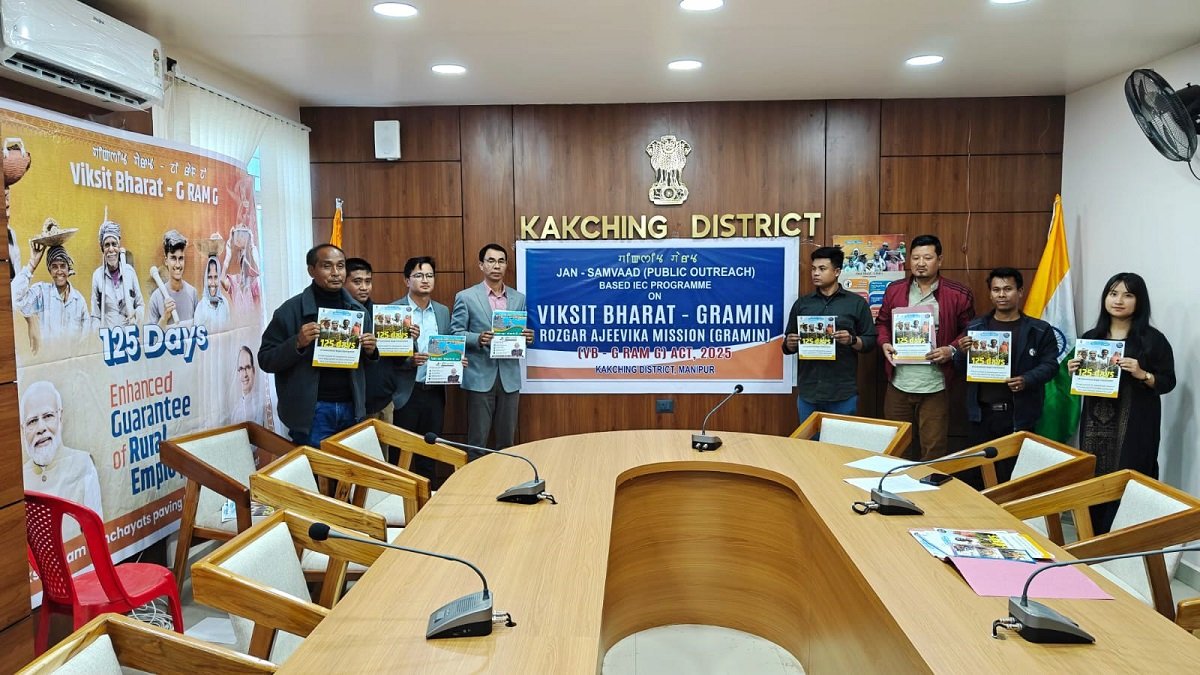

The Government is conducting a structured six-week Jan Samvaad (Public Outreach) based Information, Education and Communication (IEC) campaign for dissemination of the provisions of the Viksit Bharat — Guarantee for Rozgar and Ajeevika Mission (Gramin) Act, 2025 (VB-G RAM G) across all the districts in the State.
The statement was made by Additional Deputy Commissioner, P. Shantikumar Singh at a Jan Samvaad (Public Outreach) based IEC programme held at Conference Hall, DC Office Complex in Kakching district attended by district officials, including officials from Rural Development & Panchayati Raj (RD & PR) and District Information Office (DIPR).
Shantikumar informed that the Act was notified on December 21, 2025, replacing the Mahatma Gandhi National Rural Employment Guarantee Act (MGNREGA), 2005.
P. Shantikumar Singh stated that works under the new legislation will be aligned with the broader national mission of Viksit Bharat@2047, with planning to be carried out at the grassroots level through the preparation of a Viksit Gram Panchayat Plan at each Gram Panchayat.
He informed that under the new provisions, a rural household may be entitled to up to 125 days of unskilled manual work in a year, an increase from the earlier 100-day limit. Wages will be paid at prevailing rates within 7 days of completion of work, with an extension period of up to 15 days, he added.
P. Shantikumar Singh further said any adult member of a rural household willing to undertake unskilled manual work can register with the concerned Gram Panchayat and obtain a Gramin Rozgar Guarantee Card, commonly referred to as a Job Card. Once registered, a household possessing a Job Card may apply for work either orally or in writing to the GP/PO or other concerned authority.
He continued that if employment is not provided within 15 days of such application, the applicant becomes eligible for unemployment allowance. The allowance is fixed at one-fourth of the wage for the first 30 days and 50 per cent of the wage for days exceeding 30 days. However, unemployment allowance will not be admissible to individuals who fail to report for assigned work, those who have already completed 125 days of employment or those who have received wages and unemployment allowance equivalent to 125 days of wages, he added.
He further stated that no works will be taken up for a period of 60 days during peak agricultural seasons, particularly during sowing and harvesting.
Highlighting the thematic focus areas under the Act, P. Shantikumar Singh explained that priority will be given to water security-related works, like construction of canals, ponds, check dams, wells, plantations and rainwater harvesting. Core infrastructure projects such as roads, culverts, crematoria, schools, hospitals, waste management assets, parking areas and works related to schemes like Pradhan Mantri Awas Yojana – Gramin and Jal Jeevan Mission will also be undertaken, he added.
He said the Act also provides for livelihood infrastructure development, including training centres, markets, grain storage, compost structures and agriculture and fishery-related works. He continued that in view of climate-related risks, mitigation of extreme weather events has been incorporated, covering construction of flood and cyclone shelters, post-disaster rehabilitation, forest fire prevention infrastructure and plantations.
He also added that the Act allows for maintenance of public assets and works for individual beneficiaries under various Central Government schemes.
Concluding his address, P. Shantikumar Singh added that the new Act will contribute to the development of villages in Kakching district and across the country, reinforcing the goal of building a developed India (Viksit Bharat) by the year 2047.
The remaining five weeks of IEC campaign will be participated by Block Development Officer, Programme Officer, Gram Panchayat, Gram Rozgar Sahayaks, Panchayat Secretary, SHGs, frontline workers and other stakeholders.
Jan Samvaad based IEC campaign held in Kakching