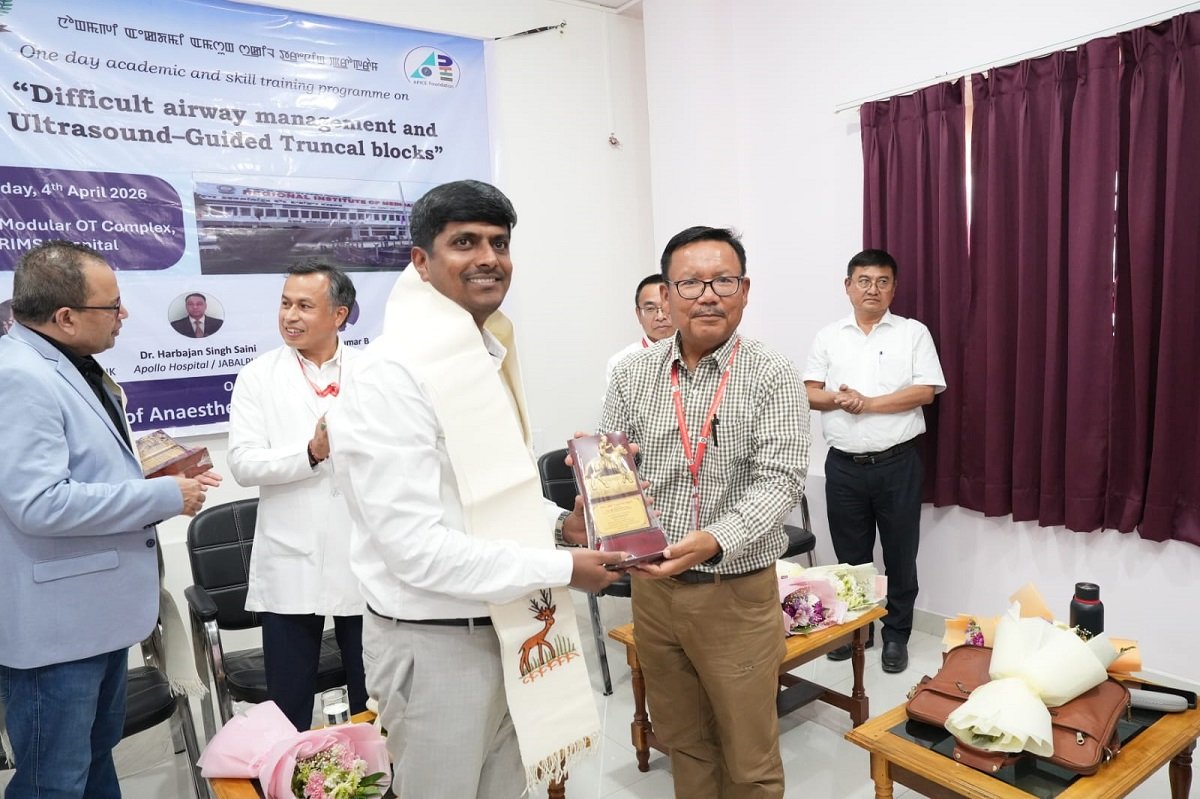

A one-day academic and skill training programme on Difficult Airway Management and Ultrasound-Guided Truncal Blocks was successfully conducted today at the Modular OT Complex of the Regional Institute of Medical Sciences (RIMS), Imphal. The programme was organised by the Department of Anaesthesiology, RIMS, Imphal, with the objective of enhancing clinical skills and knowledge among healthcare professionals in advanced airway management and regional anaesthesia techniques.
The programme was formally inaugurated by Prof. G. Sunil Kumar Sharma, Director, RIMS, Imphal, in the presence of Prof. N. Sanjib Singh, Medical Superintendent of RIMS Hospital, Imphal; Prof. L. Rajesh Singh, Dean (Academics); Prof. Gojendra Rajkumar, Head of the Department of Anesthesiology, RIMS, Imphal; and Dr. Shivkumar Singh, Course Director and Consultant in Anaesthesia at University Hospital Liverpool, UK. Other distinguished dignitaries included Dr. Harbajan Singh Saini of Apollo Hospital, Jabalpur; Dr. Anil Kumar of KIMS Hospital, Bengaluru; and Dr. Irine Bey Pi of JJM Hospital, Dibrugarh.
Speaking at the occasion, the RIMS Director noted that the Department of Anaesthesiology is the largest in the institute with a rapidly growing workforce. He highlighted recent developments, including improved infrastructure and advancements in cardiac anaesthesia, with nearly 70 cardiac surgeries and renal transplants since early 2025.
He emphasised the importance of skill and preparedness in difficult airway management and the role of ultrasound-guided truncal blocks in improving patient outcomes. He added that such programs bridge theory and practice and stressed strengthening anaesthesiology services to reduce referrals and enhance healthcare delivery.
The training programme featured a series of expert lectures, live demonstrations, and hands-on sessions focusing on the management of difficult airways and the use of ultrasound in administering truncal blocks. The programme saw active and enthusiastic participation from faculty members, HODs, residents, and nursing staff. Sessions were conducted by renowned faculty, including international experts and specialists, who created a dynamic and interactive learning environment, facilitating rich knowledge exchange among participants.
RIMS conducts academic and skill training programme