
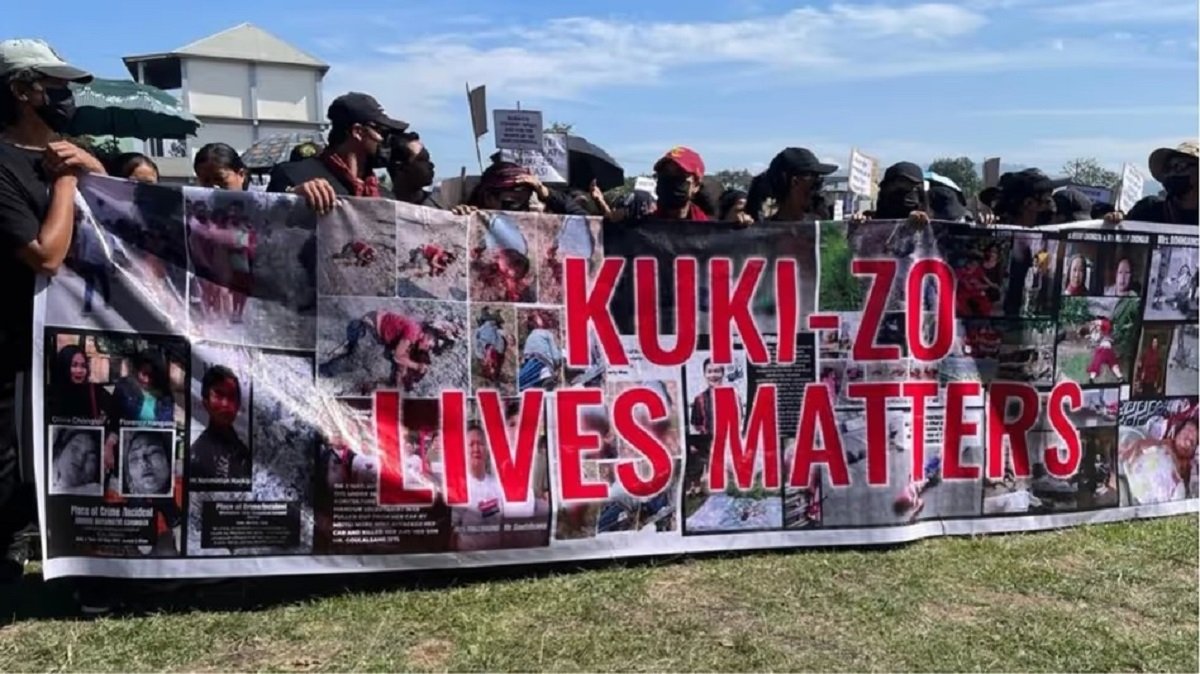
The question of identity, historical recognition and political rights of the Kuki-Zo community took centre stage as community leaders, scholars and legal experts called for constitutional safeguards, civilian protection and a lasting political solution to the ongoing crisis in Manipur.
The discussions were held during a programme organised by the Kuki-Zo Women’s Forum, Delhi and NCR at the Constitution Club in New Delhi on the occasion of Janjatiya Gaurav Divas under the theme, “Honour the War, Recognise the People, Deliver the Solution.”
Speakers highlighted concerns over the community’s identity, representation and future political status while reiterating the demand for a separate administrative arrangement for Kuki-Zo inhabited areas.
Prof. Prasenjit Biswas of North-Eastern Hill University (NEHU) alleged that the Kuki-Zo community had faced repeated attacks, displacement and human rights violations since ethnic violence erupted in Manipur. He also claimed that the community continued to face political and economic marginalisation, citing inadequate representation and a lack of infrastructure in hill areas.
Making a case for constitutional safeguards, Biswas suggested that Articles 239A and 244A of the Constitution, along with the Sixth Schedule, could offer a framework for greater autonomy in hill areas without affecting Manipur’s territorial integrity. He also advocated constitutionally protected rights over natural resources, including forests, rivers and minerals.
Robert Lunkhopao Haokip, a Harvard research fellow, highlighted the historical contributions of the Kuki-Zo people, including their association with the Indian National Army (INA), and called for greater recognition of their role in India’s freedom struggle.
Legal expert Advocate Vishwajeet spoke about the humanitarian consequences of the conflict, particularly its impact on women and children. He stressed the need for civilian protection, accountability for violations and dignified rehabilitation for displaced persons.
Seilen Haokip, Chairman of the Kuki National Army (KNA) and spokesperson of the Kuki National Organisation (KNO), said the demand for a separate administration was intended to secure the community’s socio-political and economic rights within the framework of the Indian Constitution and did not imply separation from India.
He stated that discussions with the Centre on issues concerning land, forests and natural resources were continuing, though no final agreement had been reached.
Addressing questions over indigenous identity, Haokip asserted that the Kuki-Zo people have a long historical presence in the region and have contributed significantly to the country’s history, including the freedom movement.
On the Suspension of Operations (SoO) agreement, Haokip said that although the pact had not been formally extended, its provisions continued to function on the ground. He explained that the arrangement allows security forces and armed groups to avoid hostilities while facilitating ongoing political dialogue.
Participants at the event renewed calls for constitutional safeguards, greater political recognition and a negotiated settlement to address the concerns of the Kuki-Zo community amid the continuing crisis in Manipur.