
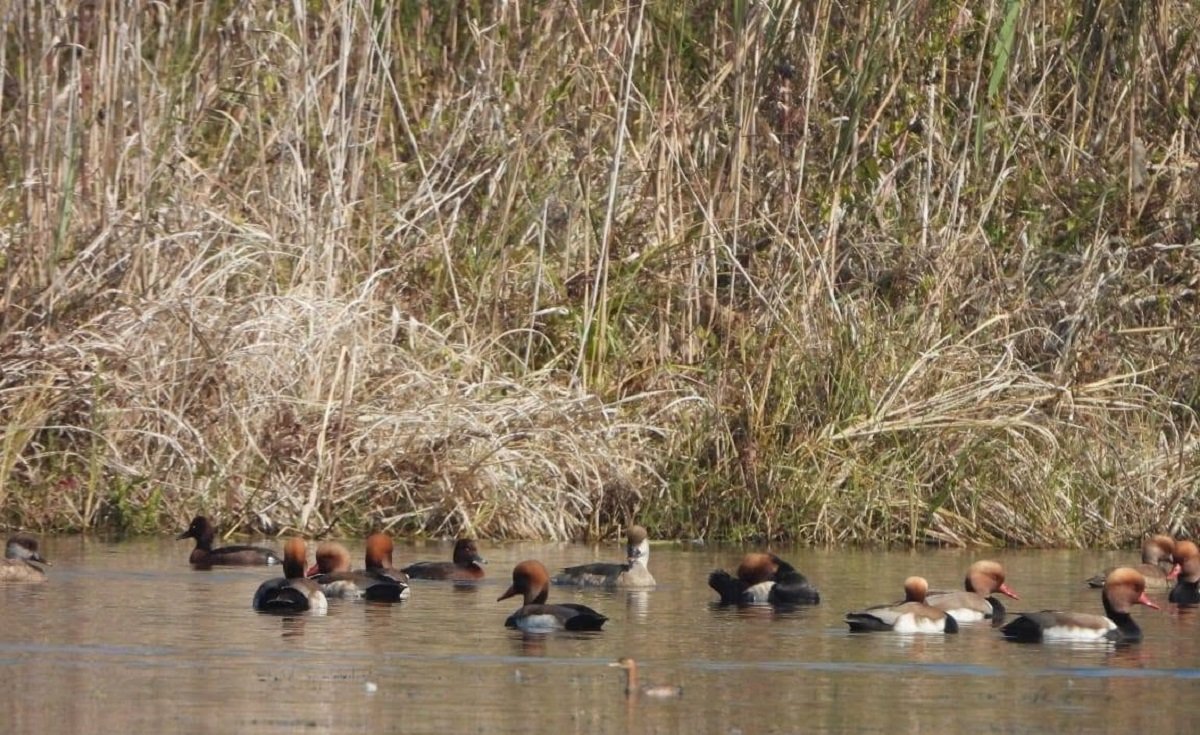
The population of waterbirds at Manipur’s Loktak Lake, the largest freshwater lake in Northeast India and a Ramsar wetland site, has witnessed a significant decline this year, raising fresh concerns among conservationists and environmental experts.
According to the Waterbird Census Report – Loktak Ramsar 2026, the lake recorded a total of 16,365 waterbirds this year, down from 23,390 birds counted in 2025. The report highlights a long-term downward trend, with bird numbers falling sharply from a peak of 50,725 recorded in 2015.
The census data shows fluctuating numbers over the past few years. Loktak Lake hosted 47,472 waterbirds in 2022, but the figure dropped to 23,105 in 2023 and further to 14,235 in 2024, the lowest count in a decade. While the population rebounded to 23,390 in 2025, it declined again this year.
Despite the fall in overall bird numbers, the report noted an increase in species diversity. A total of 56 waterbird species belonging to 14 families were recorded this year, compared to 53 species last year. Of these, 24 species were resident birds, 29 were migratory, and three were local migratory species.
The Anatidae family, which includes ducks, geese and swans, accounted for the highest number of species, followed by the Ardeidae family, comprising herons, egrets and bitterns.
Among individual species, the lesser whistling duck recorded the highest population with 5,373 birds, followed by the common coot with 2,560 and the common moorhen with 1,173.
The report attributes the decline in bird numbers primarily to human-induced and environmental pressures, including encroachment, pollution, siltation, habitat alteration, light pollution, overfishing and poaching. These persistent threats have kept Loktak Lake on the Montreux Record since 1993, a list of Ramsar sites experiencing ecological changes.
The report also noted that the current bird population remains below Criterion 5 of the Ramsar Convention, which requires internationally important wetlands to regularly support at least 20,000 waterbirds.
To address the issue, the report recommends continuous monitoring of bird populations, habitat conditions and species composition. It also suggests declaring key bird congregation sites as conservation reserves or community reserves in partnership with local communities to strengthen protection efforts.
Conservationists believe that without stronger ecological management and habitat protection measures, the long-term health of Loktak Lake and its rich biodiversity could face increasing challenges.